More of what you love. Less retail markup.
Choose cabinet glass by testing visibility, interior finishes, pattern direction and lighting with the objects you plan to store.
Plan my kitchen with a free design & quote
In this guide
Glass-front cabinets change what you are designing. You are choosing not only a door, but also the view through it: shelves, dishes, interior finish, lighting and the ordinary contents of a working kitchen.
For a Baltimore remodel, decide how much you want to reveal before choosing a glass pattern. Clear, textured and opaque options can produce very different results even in the same cabinet frame. A small sample held against a white wall will not tell you how the completed cabinet will feel after dinner.
Learn from a local display built around glass
Swanson Design's account of the Sunnyfields showroom in the Baltimore region describes kitchen displays around a central glassware area, with concealed lighting influencing how the glass reads. The useful observation is that the objects, surrounding cabinetry and light are experienced together. Baltimore-region showroom design.
Apply that principle when reviewing your own cabinet samples. Bring an everyday plate, a glass and a typical pantry container, or photographs and measurements if physical samples are impractical.
Choose a representative display, not only the pieces you would arrange for a photograph. Your kitchen should look good with the things that actually live there.
Set a visibility goal
Clear glass makes contents part of the cabinet's visual composition. A textured or etched option may soften details while allowing shapes and light to remain noticeable. An opaque glass treatment serves a different purpose: the glass surface becomes the visual feature rather than a view into storage.
Bendheim's decorative-glass guidance discusses patterned and etched glass for obscuring detail, as well as fluted patterns and opaque categories. The amount of concealment still needs to be judged with the exact sample and conditions you intend to use. Manufacturer decorative-glass guidance.
Avoid treating “reeded,” “frosted” or “textured” as a guarantee of privacy. Ask to see how much remains visible with the cabinet interior illuminated and with objects close to the glass.
Compare what you want the door to do
| Desired effect | Option to examine | Sample test |
|---|---|---|
| Display a selected collection clearly | Clear glass | Are shelves, supports and everyday arrangements attractive? |
| Suggest contents without showing every detail | Textured or etched glass | What remains visible at normal viewing distance? |
| Add rhythm to a quiet cabinet wall | Directional patterned glass | Does the pattern run consistently across adjacent doors? |
| Use glass as a decorative surface | Opaque or back-painted treatment | Does the surface color work with the frame and nearby finishes? |
| Mix display and concealed storage | Limited glazed cabinets among solid fronts | Are the chosen display locations convenient to maintain? |
You can use glass selectively. One considered display area may suit your routine better than making every upper cabinet a presentation space.
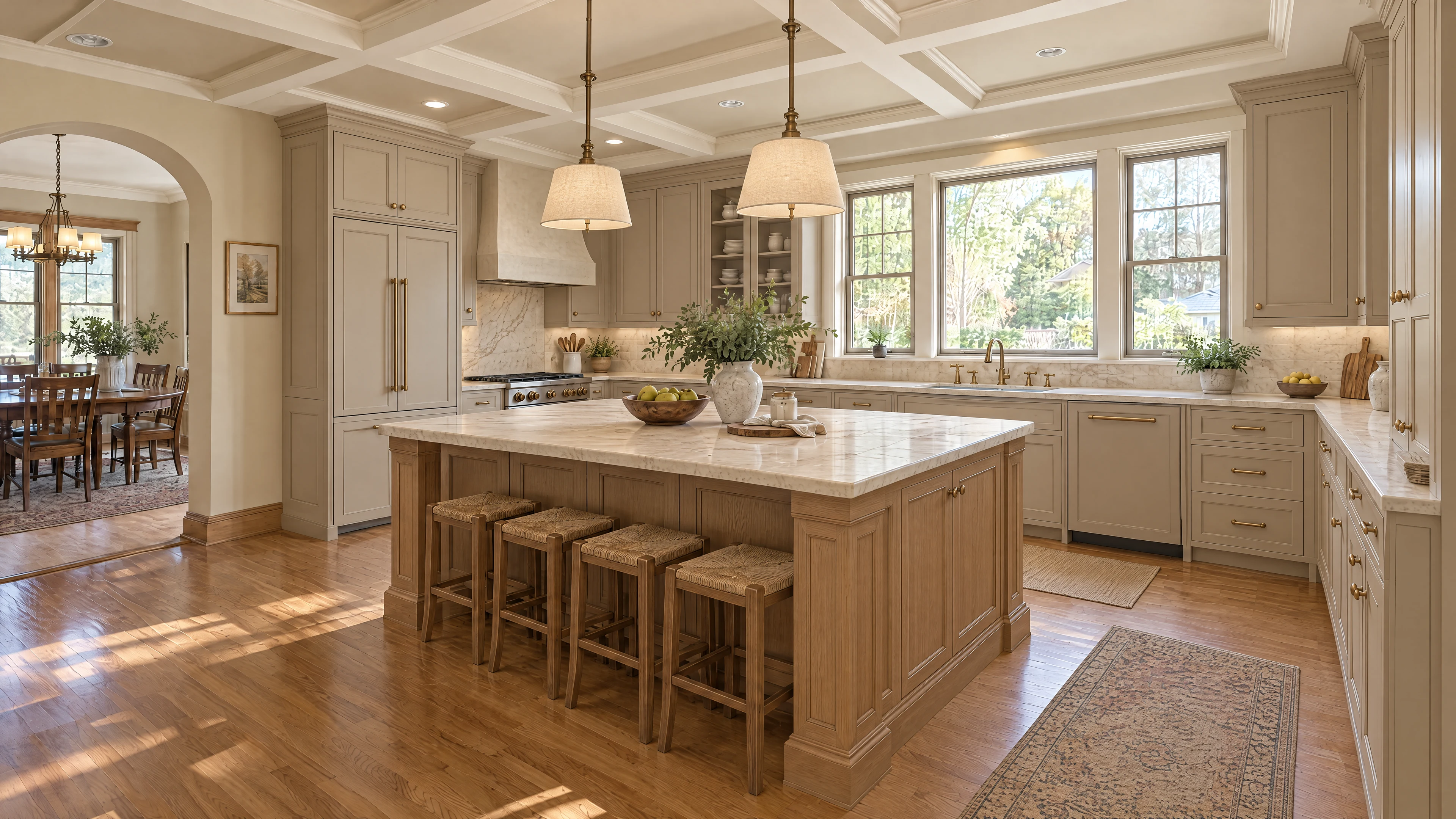
Test the glass in a cabinet-like setting
Ask to place the sample in front of a box or display with a similar interior color. Put representative objects behind it and look from the positions you will occupy: standing at the counter, seated at the island and approaching from the adjacent room.
Repeat the review with interior lighting on and off, where available. A pattern that obscures objects in one condition may reveal them differently in another.
Check the sample's orientation. A directional pattern should be specified deliberately, especially across pairs of doors or cabinets of different heights. Label the approved orientation on the elevation rather than leaving it to interpretation.
Review the edge where glass meets the frame. The width and profile of the frame contribute to the final effect, so an isolated sheet of glass is only part of the selection.
Finish the interior you will see
Ask what the standard cabinet interior looks like and whether the proposed glazed cabinet includes a different finish. Do not assume it matches the exterior paint or wood.
Examine the shelves, shelf supports and any visible hardware. With clear glass, these details may be as noticeable as the objects you plan to display. With textured glass, their outlines may still influence the composition.
Choose shelf spacing around the actual items rather than a symmetrical drawing alone. Can the tallest pitcher fit? Can a serving piece be removed without moving everything above it? Where will less attractive everyday items go?
If you add interior lighting, coordinate its visible position and control separately from the counter task lights. Ask whether the source or wiring will be visible through the chosen glass and how components remain accessible.
Specify the complete glazed door
The cabinet and glass professionals should confirm the appropriate glass type, thickness, dimensions, edge treatment, retention method and suitability for the application. They should also verify compatibility with the door and hardware.
Do not select a glass solely by appearance and assume it fits every frame. A change in the proposed glass or cabinet construction is a reason to reconfirm the assembly.
Ask which side carries any surface treatment and what cleaning instructions apply. Keep the manufacturer's care information with the project documents so the finished glass is maintained appropriately.
For replacement planning, record the exact glass name and specification rather than relying only on a photograph. A similar-looking pattern may have a different scale, color or construction.
Make the quote show the whole effect
Use a worksheet listing cabinet number; frame finish; glass selection; pattern orientation; interior finish; shelf material and spacing; visible supports; lighting; and professional fitting responsibility.
Then check the price for each element. One proposal may include finished interiors and lighting while another covers only the glass inserts. Without those distinctions, an apparently comparable pair of cabinets may deliver quite different results.
Ask for the sample approval and final elevation to refer to the same selection. If you later simplify the package, identify what remains visible and whether the original design intention still holds.
For broader planning, visit HIBC's Baltimore kitchen design guide and cabinet finish checklist.
Create a display you will enjoy living with
Request free kitchen design and a product-quote conversation before joining HIBC. Bring the visibility goal, samples and contents list so the independent showroom can discuss the complete cabinet arrangement.
HIBC is an online buying club with no HIBC product markup, not an installer. Gold membership is $4,995 initially, with an optional $495 annual renewal purchased separately and no automatic charges. Cabinetry, glass, lighting, delivery and installation are separate project costs. Choose the view you want first, then compare the full package needed to create it.
