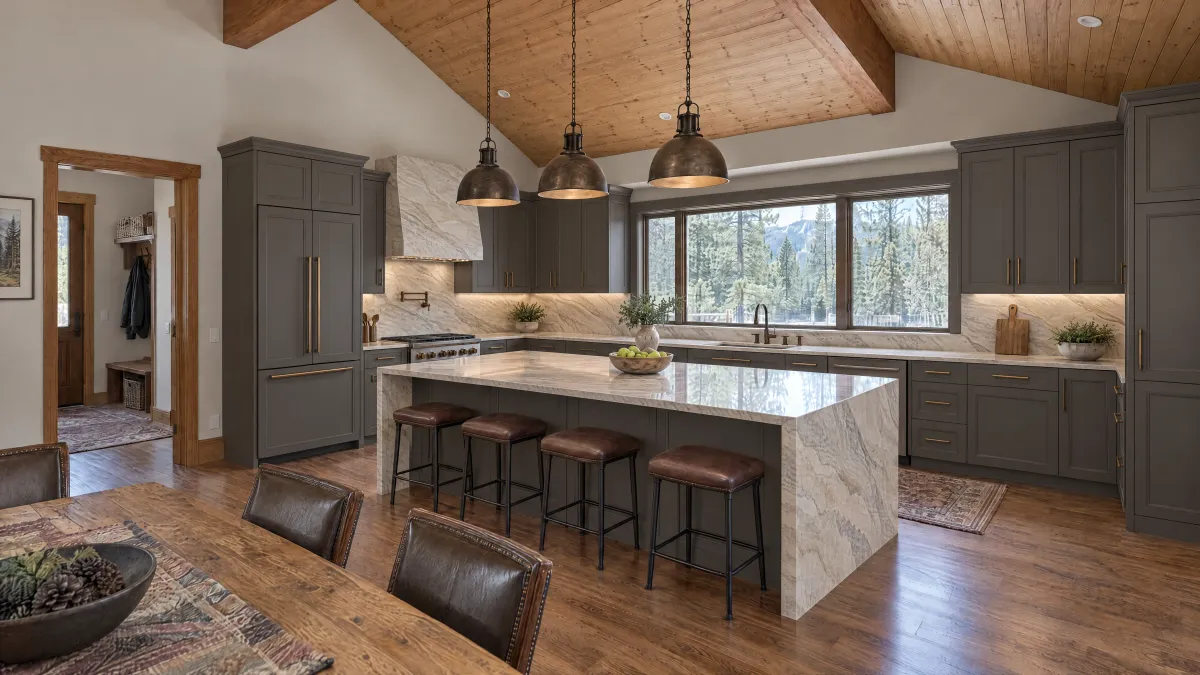
Start with where preparation actually happens
For a Los Angeles kitchen, choose one ordinary preparation task and identify where its ingredients, bowl and waste container go. Compare that arrangement with a cutting-board drawer extended at its proposed cabinet location. Then repeat the task using a separate board on the intended counter.
Rev-A-Shelf describes a cut-out cutting-board drawer offered in different sizes for cabinet applications. This establishes one type of assembly, not that it fits your cabinetry. Ask the provider to identify the complete product, cabinet requirements and documented intended use.
Compare the space during the task and afterward
Have the designer show what the extended assembly occupies beside nearby doors, drawers and people moving through the kitchen. Check whether another cook could retrieve the items needed at the same time. A board that disappears when closed can still change how the room works during preparation.
Ask what storage the assembly replaces. Name the utensils or other contents that need another home; do not count the same drawer as both the board mechanism and ordinary storage. With a separate board, identify a usable preparation position and a place to store it after its documented care routine.
Make cleaning and replacement part of the order
Have the supplier explain whether the selected board is removable, how its surfaces and surrounding assembly are cared for, and which replacement parts it can identify. Do not infer removability, dishwasher suitability or supported loads from a product photograph. Follow the exact manufacturer’s use and care instructions.
Save the chosen task layout with your Los Angeles kitchen planning file. The cabinet provider and installer should confirm fit and installation responsibilities. Any associated construction or service changes need review for the actual city, county and property scope; an accessory selection is not that approval.
Your decision worksheet
| Decision item | Record for each candidate |
|---|---|
| Reference task | Place the usual ingredients, bowl and waste destination on a simple preparation sketch. |
| Fixed position | Show the drawer extended and identify simultaneous access to nearby storage. |
| Counter alternative | Name where the separate board would be used and stored. |
| Displaced storage | List contents needing another location if the drawer assembly is selected. |
| Care and replacement | Request exact instructions, removal information and identifiable replacement components. |
| Complete order | Confirm assembly, compatible cabinet, fitting responsibility and the chosen task layout. |
A worked buying example
Hypothetical example: a homeowner wants a pullout board to keep the counter clear. The proposed position occupies the drawer normally used for utensils and crosses a second cook’s route to a pan. After comparing the task in both locations, the household keeps a separate board and its storage space. Another layout could favor the drawer; the useful result is an explicit choice.
Questions to settle before ordering
Does the cutting-board drawer add preparation space without a tradeoff?
Compare its extended position and the cabinet storage it replaces. The answer depends on the complete assembly and how your household uses that location.
Can I assume a built-in board lifts out for washing?
No. Ask about removal and the prescribed care routine for the exact product before ordering.
