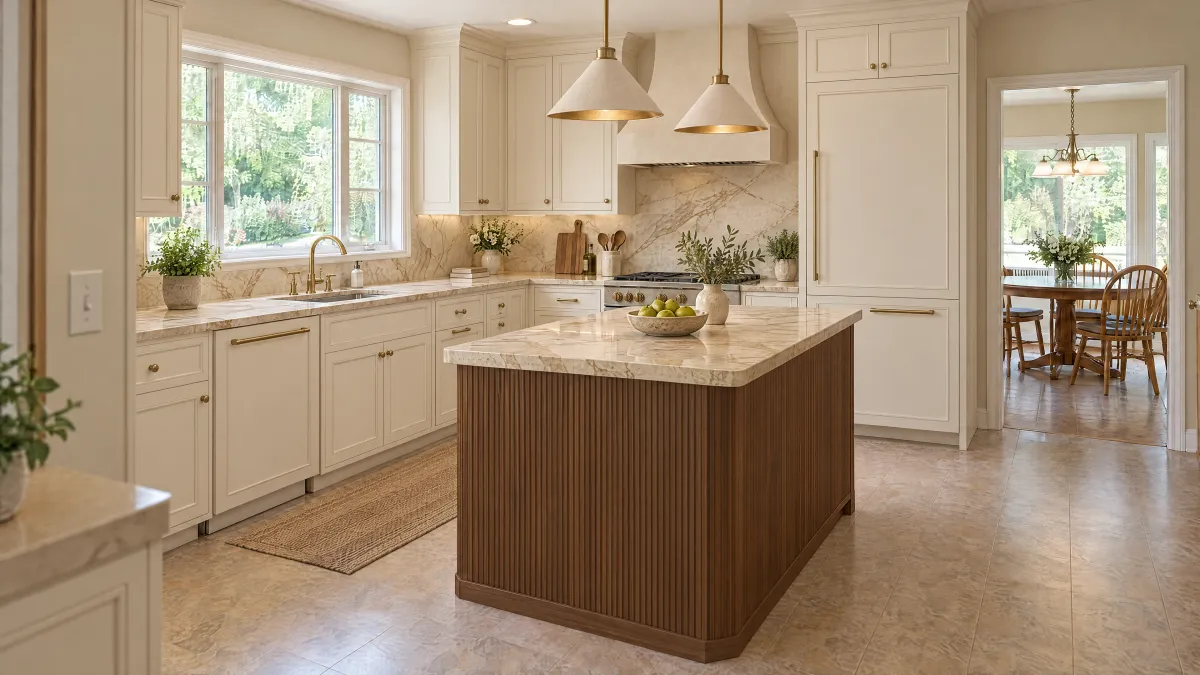
Compare the drawing to the list, not just the total
Two Kansas City kitchen quotes can show the same number of cabinet boxes and still describe different finished rooms. An exposed island back, a finished end beside an appliance or a filler at a wall may sit on a separate order line. Start with the current drawing and mark every visible surface and transition. Ask each seller to identify the product that finishes it.
This is a completeness check before a price comparison. It does not mean every kitchen needs every accessory. A wall that hides a cabinet side and an island with three exposed faces have different requirements. Ask what is required for your approved arrangement and where it appears in each proposal.
Use a component map
Give each cabinet run and island face a simple label. Beside each label, record the cabinet item, quantity, finish and the matching end, panel, filler, toe kick or molding if required. Keep included items visible even when their cost is bundled. An empty price cell is not evidence that the part is supplied free.
KraftMaid's specification guides illustrate why the exact product line matters: sizes, styles and finish options are documented in its own guides. Have the seller use the current specification for the quoted line, rather than a dimension remembered from another manufacturer.
Ask one reconciliation question at a time
When a part appears on one proposal but not the other, ask whether it is separately priced, included elsewhere, excluded or unnecessary for that design. Request the answer against an item number or drawing location. Do not simply add the more expensive proposal's accessories to the cheaper one; the cabinet construction or design may differ.
Then separate products from services. Cutting or fitting a filler, finishing an exposed surface, delivering parts and installing them are different responsibilities. Confirm who supplies the item and who performs the work. For a project on either side of the Kansas City state line, use the actual delivery address and responsible project professionals when checking taxes, trade scope and requirements; this worksheet does not determine those amounts.
Your decision worksheet
| Check | What to confirm |
|---|---|
| Drawing revision | Use the same dated layout for both proposals. |
| Exposed surfaces | Identify each visible side, island back and appliance transition. |
| Part and quantity | Match the required product code, finish and quantity to a line item. |
| Price treatment | Mark separately priced, included elsewhere, excluded or not needed, with an explanation. |
| Supply versus fit | Name the supplier and installer for each finishing component. |
| Unresolved total | Keep unknown required items out of any claimed savings calculation. |
Worked example: matching box counts, different island scope
Suppose both proposals contain 18 cabinet boxes. Proposal A lists an island back panel and two finished ends; Proposal B does not. The drawing shows those three surfaces exposed. Ask B's seller to point to the included parts or revise the written scope. If B uses a different cabinet construction that already supplies a finished side, record that explanation instead of adding a duplicate panel.
Compare totals only after that answer, quantities and installation responsibilities are aligned. The useful result is a reconciled order list, not a guessed price adjustment.
Questions to settle before ordering
Does a missing line always mean an incomplete quote?
No. It may be included elsewhere or unnecessary for a different construction. Obtain a specific written explanation.
Should I compare only the cabinet subtotal?
Use matched product scope first, then account for membership, applicable taxes, delivery and separately arranged services in the complete comparison.
